By Bruce Wenning/ Special To The Tab
During the winter our environment is inundated with road salt. Millions of tons of de-icing salt, commonly called rock salt (sodium chloride) is applied to roads, parking lots, sidewalks, driveways, and stairs to melt ice or prevent ice formation. This is done to reduce the hazard of pedestrian slips and falls and vehicle accidents. However, it is not effective below 20 °F.
However, rock salt applied for our safety has several non-target pathways in the environment: (1) it seeps into pavement surfaces and creates a reservoir of salt for later transport for contamination, (2) it is splashed to roadside soil and vegetation by vehicles where it is concentrated in plowed and shoveled snow piles (3) it is washed away by surface runoff into soil, ground water, rivers, lakes, ponds, and streams (4) it leaches through soil into the plant root zone (5) it becomes air-borne into our atmosphere and settles on vegetation (6) it gets onto vehicles and roadway structures contributing to corrosion.
Rock salt is toxic to many perennial plant species of trees, shrubs, grasses and herbs. Salt-contaminated snow and ice eventually melt and leach into soil, killing soil microbes, which contributes to soil compaction.
Rock salt in soil breaks down into ions of sodium and chloride. The chloride ions are the more damaging; when taken up by plant roots in spring and summer they are transported to growing points such as buds and branch tips, killing them. Leaves show symptoms of salt damage by exhibiting brown colored leaf margins. This is where chloride ions were deposited and concentrated in the leaf tissue, creating localized cell death that resembles drought stress. Eventually entire leaves can “brown out” and die. Twigs and small branches can soon follow suit.
Vehicular traffic on salted roads releases pavement salt, making it airborne. Rock salt molecules travel in wind currents created by traffic flow and settle on roadside vegetation. This action, called salt spray, can cover trees as high as forty feet and an area as deep as 150 feet from the road, although the most noticeable plant damage is within thirty feet of the road. Contaminated soil and salt spray are the two most common ways plants get injured from road salt.
Repeated exposure to rock salt by salt sensitive deciduous trees will cause bud death and branch dieback, forcing dormant buds below the affected area to grow out in response. This recovery growth response of multiple stems with leaves is called “witches brooms” and it is diagnostic of salt exposure. It is easily observed on cherry and maple trees along heavily salted roadsides. Another sign of rock salt toxicity is summer and early fall defoliation.
Evergreen trees such as hemlocks and pines show brown-tipped needles well into summer. With annual exposure to salt spray from traffic or soil contamination, the needles turn completely brown, die and fall off. Evergreens and salt-sensitive deciduous plants are weakened by repeated exposure to rock salt, increasing their susceptibility to insects, diseases and fertility problems; this can lead to their premature death.
There are protective measures you can take to lessen the effects of rock salt damage to plants. First, switch to sand or use ice melting products that are safer for plants, pets, and the environment, such as potassium chloride or “pet safe” calcium chloride products, which are effective de-icing compounds to -15 °F and below. Although these products are a little more expensive than rock salt, they significantly reduce plant damage and environmental contamination. Second, plant salt-tolerant plants. Third, protect salt sensitive plants with burlap wraps, wooden coverings facing the road and by flushing the root zone in spring and summer with lots of water, although root zone washing is only effective with well-drained soil.
Pirone’s Tree Maintenance (7th ed.), Hartman, Pirone and Sall. ranks trees from “Very tolerant” (least sensitive) to “Intolerant” (most sensitive), as follows: Very tolerant:White oak, red oak, black cherry, and eastern red cedar. Tolerant:Yellow birch, black birch, paper birch, gray birch, black locust, and largetooth aspen. Moderately tolerant: Norway maple, red maple, shagbark hickory, hop-hornbeam, American elm, and linden. Intolerant: Sugar maple, white pine, hemlock, beech, red pine, and speckled alder.
For more information, see: www.UMassGreenInfo.org, www.extension.umn.edu, www.safnet.org.
Bruce Wenning is Horticulturist / Grounds Manager at the Massachusetts Audubon Society’s Habitat sanctuary, Belmont and serves on the Board of Directors for the Ecological Landscaping Association. www.ecolandscaping.org.

 Zoos are uniquely positioned between the increasingly urbanized human world and the world of wildlife. We are the most effective bridge linking these two disparate worlds. The irony is, of course, that these are not two worlds at all; humans and wildlife are inhabitants of one planet and the survival of all of us is inextricably linked. The bridge we zoos create is built with informational logs and intellectual mortar provided through our exhibits, our signage and our programming. The underpinnings of the bridge lie in the creation of emotional bonds between people and animals. In establishing these bonds, the animals in our Zoos serve as ambassadors par excellence for their wild living brethren. Once established, this is a "bridge" that grows and takes on a life of its own. The challenge for zoos today lies in knowing that there is much bridge construction to be done if we are to secure a healthy future for the children and grandchildren of the Earth’s current inhabitants.
 In our area, there are three important insect pests that can tolerate cold weather. The first is a dull brownish moth that is drawn to house lights at night. Called the Winter Moth (Operophtera brumata), the males can be seen by the hundreds covering the sides of buildings, doors, and windows at dusk and dawn. (The wingless females are flightless.) This pest, which resembles our native Fall Cankerworm Moth - and makes its appearance at about the same time - is new to the area. However, Winter Moth is well known on the South Shore and Cape Cod, where oaks, maples, crabapples, cherries and other trees and shrubs have been partially to completely defoliated over the past few years.
 Since that time, our forests have returned, and now an estimated 70% of Massachusetts is covered with second growth. This has led to restoration of wild animal populations, with the exception of wolves and mountain lions, entirely extirpated from the Northeast through bounty hunting. As housing has exploded into rural areas, with developments rising in forested landscapes, human encounters with wildlife have increased. Suburban gardens, shrubs, fruit trees, and bird feeders provide tempting food for many wild creatures, and garbage added to mulch piles or left outside in trash bags spells "dinner" for raccoons, skunks and coyotes. Crawl spaces under porches and garages attract these same animals, also foxes, as dens for rearing young. With hunting prohibited, large predators absent, food supplies handy, and living space provided, why should they forego such comforts?
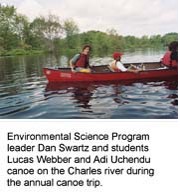 This episode of The Environmental Show travels along with teens as they go hiking, biking, canoeing and climbing, and visit woods and ponds, the Charles River, parks, a salt marsh, and mountains, winding up with a stay at the highest peak in the northeast (Mt. Washington). They also participate in a hands-on environmental cleanup project each year. As several of the teens point out, they make friends and have fun while they’re out there.
 Tragically, nearly a quarter of all bat species are threatened by extinction, mainly due to habitat loss, hunting, disturbance at roost sites and pesticides. Conservation has been greatly impeded by a lack of understanding of these animals. Demonized and feared across cultures for centuries, shrouded in myth and prejudice, bats now face another challenge to their unfairly tarnished image - their role as natural wildlife reservoirs in the emergence of new and sometimes fatal infectious diseases.